Creator Fee Tracker
Defensive Accelerationism
Build the future faster, and build the tech that protects people first.
Every trade of this coin on pump.fun pays a creator fee. A bot claims those fees, bridges them from SOL to ETH on Ethereum, and sends them to the wallet below. Every step links to the blockchain so anyone can check it. Not affiliated with or endorsed by Vitalik Buterin.
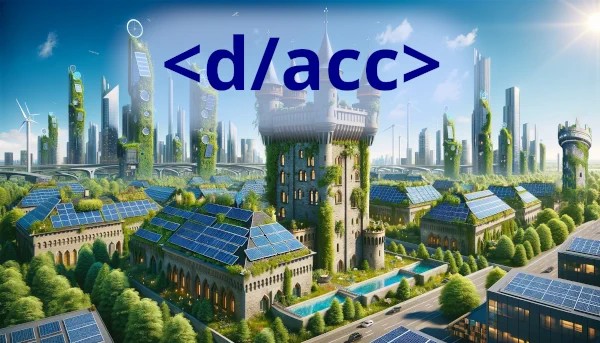
d/acc: Defensive Accelerationism
d/acc, short for defensive accelerationism, is Vitalik Buterin's answer to e/acc (effective accelerationism). Both want technology to move faster. The difference is which technology comes first. Vitalik laid it out in his essay My techno-optimism (27 Nov 2023) and updated it in d/acc: one year later (5 Jan 2025).
View Vitalik Buterin's post on X
The idea in one line
Some technologies make it easier to attack. Others make it easier to defend. Speed up the defensive ones first.
Why defense matters
When attacking is cheap and defending is hard, people end up relying on a powerful central authority to protect them, and that authority gets to set the rules. When defending is cheap, small groups, open communities and free societies can look after themselves. Vitalik's example is Switzerland: its mountains made it hard to invade, which helped its decentralized politics last for centuries. d/acc asks what the "mountains" of the digital and biological world look like, and says: build those.
Not "slow down"
d/acc is still pro-technology. It rejects the "decel" view that progress should stop. It also rejects the idea that every technology is equally good to speed up. The goal is differential progress: pull the protective, power-spreading tech ahead of the dangerous, power-concentrating tech.
The four D's
What defensive tech looks like
- Macro physical: resilient infrastructure, self-sufficient living, missile defense.
- Bio: pandemic readiness — far-UVC light, air filtering, wastewater monitoring, open-source vaccines, early outbreak detection.
- Cyber: cryptography, blockchains, zero-knowledge proofs, formal verification, secure hardware.
- Info: Community Notes-style fact checking, prediction markets, tools that help people spot scams and find the truth.
d/acc and AI
The 2025 update gets specific about AI with two proposals. First, make the people who build and deploy AI liable for the harm it causes. Second, keep a global "soft pause" option in reserve: industrial-scale AI hardware would need a weekly cryptographic sign-off to keep running, so the world could slow things down if AI became dangerous, without anyone needing to take control of it.
Survive and thrive
The 2025 update adds a second axis. The same tech that helps us survive (security, pandemic defense) often helps us thrive (longevity research, brain-computer interfaces, better tools for working together). d/acc is about both. It also proposes "deep funding", a way to use AI and many small human judgments to fund open-source public goods fairly.
e/acc vs d/acc
| e/acc | d/acc | |
|---|---|---|
| Full name | Effective accelerationism | Defensive accelerationism |
| Founded by | Beff Jezos (Guillaume Verdon) and others, 2022 | Vitalik Buterin, 2023 |
| Speed up | All technology, as fast as possible | Protective, decentralizing tech first |
| Who decides | The market ("techno-capital") | People choosing on purpose ("differential") |
| AI risk | Mostly overblown; regulation helps incumbents | Real; answer with liability and a soft-pause option |
| Biggest worry | Stagnation and regulatory capture | Power concentrating, and attacks outpacing defense |
The two sides debated head-to-head in March 2026 on a16z's crypto show. Beff Jezos argued that "AI safety" can be used by big institutions to grab control, and that restricting chips just hands the lead to rivals. Vitalik argued for building defenses that keep power spread out as AI gets stronger.
Timeline
- 2022 e/acc starts as a meme movement on Twitter.
- Nov 2023 Vitalik publishes My techno-optimism, introducing d/acc.
- Nov 2024 First "d/acc Discovery Day" at Devcon.
- Jan 2025 d/acc: one year later adds the AI proposals and survive/thrive.
- Mar 2026 Vitalik vs Beff Jezos debate: e/acc vs d/acc.
Read Vitalik's originals: My techno-optimism (2023) d/acc: one year later (2025) Vitalik's d/acc post on X (2023) Vitalik vs Beff Jezos debate (2026)
Addresses
Activity
| When | Step | Amount | Status | Proof |
|---|---|---|---|---|
| Loading… | ||||